Art Deco Floral Seamless Patterns 06
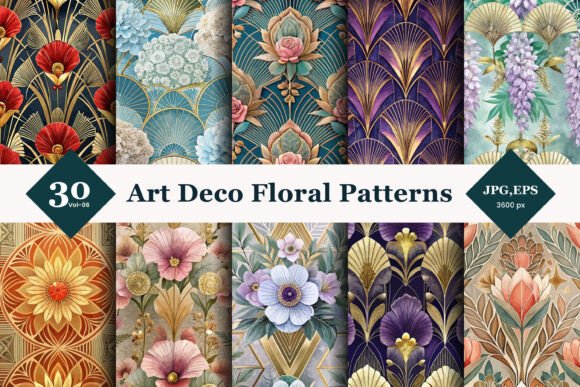
There is a specific kind of visual gravity that comes from the Art Deco era. It isn’t just about gold foil or geometric zigzags; it is about an intentional, structured luxury that feels both historic and remarkably modern. When you look at Art Deco Floral Seamless Patterns 06, you aren’t just seeing repeating shapes. You are looking at a curated collection of thirty distinct designs that bridge the gap between rigid geometry and organic elegance. This bundle offers more than just background textures; it provides a foundational aesthetic language for brands and creators who want to communicate sophistication without shouting.
The visual personality of these patterns is defined by their duality. On one hand, there are the intricate geometric shapes—sharp lines, sunburst motifs, and stepped forms—that anchor the design in the architectural precision of the 1920s and 30s. On the other, the elegant florals introduce a softness that prevents the design from feeling cold or industrial. The result is a balanced composition that feels luxurious but approachable. For designers, this balance is crucial. It allows for high-impact visuals that don’t overwhelm the viewer, making them ideal for applications where readability and brand perception matter just as much as aesthetic appeal.
Visual Characteristics and Design Appeal
To understand why these patterns work, we have to look at how they are constructed. Unlike chaotic bohemian prints or minimalist solid colors, Art Deco Floral Seamless Patterns 06 relies on symmetry and repetition. Each of the thirty unique patterns features intricate geometric shapes intertwined with stylized botanical elements. This intertwining creates a sense of movement and depth, even when the pattern is scaled down for small applications like social media avatars or business card backs.
The color palettes inherent in this style often lean towards rich, deep tones or high-contrast monochromes, which enhances the "luxurious" descriptor. However, because these are vector-based assets, the application of color is entirely up to you. Whether you choose a classic black-and-gold scheme for a wedding invitation or a muted sage and cream palette for home decor packaging, the underlying structure remains strong. This structural integrity is what makes the patterns versatile. They hold their shape and legibility whether they are used as a full-page background or a subtle watermark overlay.
The overall appeal lies in its timelessness. Trends in graphic design come and go, often favoring the ultra-modern or the retro-nostalgic. Art Deco sits comfortably in the middle, offering a sense of established prestige. When you use these patterns, you are borrowing that historical weight. You are signaling to your audience that your product or service is crafted with care, attention to detail, and a respect for traditional craftsmanship, even if the medium is digital.
Strategic Applications Across Projects
One of the most common mistakes designers make is treating decorative assets as afterthoughts. In reality, seamless patterns can define the entire mood of a project. Art Deco Floral Seamless Patterns 06 is particularly effective in industries where trust and elegance are paramount. Let’s look at how this translates into real-world scenarios.
- Fashion and Textile Design: For fabric prints, the seamless nature of these files is critical. Because the EPS vector files allow for unlimited resizing without pixelation, you can scale the pattern to fit any yardage requirement. The interplay of floral and geometric elements works exceptionally well on silk, satin, or structured cotton, adding a layer of visual interest that doesn’t compete with the garment’s silhouette.
- Wedding and Event Stationery: This is perhaps the most intuitive application. Wedding invitations benefit from the romantic yet formal vibe of Art Deco florals. Using one of these patterns as a border or a full background for save-the-dates creates immediate cohesion. When paired with a clean sans serif font for the body text and a refined script font for names, the result is a balanced hierarchy that guides the eye through the information effortlessly.
- Packaging Design: In retail, shelf presence is everything. A cosmetic brand or a premium tea company can use these patterns to create unboxing experiences that feel like gifts. The high-resolution JPG files (300 DPI) ensure that when printed on matte or glossy stock, the fine details of the geometric intersections remain crisp. This level of print quality directly influences consumer perception of value.
- Digital Branding and Web Design: While heavy patterns can slow down web loading times, using them sparingly—for hero section backgrounds, sidebar accents, or email newsletter headers—can significantly boost brand identity. These patterns serve as distinctive design assets that help a brand stand out in a crowded digital landscape filled with flat, generic templates.
Technical Flexibility and Workflow Integration
From a practical standpoint, the file formats included in this bundle address the two biggest pain points in creative production: resolution limits and editability. The inclusion of both EPS editable vector files and JPG high-resolution files means you are covered for every stage of the workflow.
If you are working on a large-scale print project, such as a billboard or a storefront wrap, the EPS format is indispensable. Vectors allow you to scale the pattern infinitely while maintaining sharp edges. You can also manipulate individual elements within the vector file if needed, adjusting the spacing between floral motifs or altering the geometric angles to better fit a specific layout constraint. This flexibility is rare in pre-made design asset bundles, where users are often stuck with fixed raster images.
For quick turnaround projects, such as social media graphics or blog post headers, the 300 DPI JPG files provide immediate usability. You can drag and drop these into Photoshop, Canva, or Illustrator without worrying about compatibility issues. The high resolution ensures that even when viewed on Retina displays or high-density mobile screens, the patterns retain their clarity. This dual-format approach saves time and reduces the need for complex conversion processes, allowing you to focus on the creative direction rather than technical hurdles.
Evaluating Fit and Pairing Strategies
Choosing the right pattern from a set of thirty requires a strategic eye. Not every pattern will suit every brand voice. If your brand is playful and youthful, a highly intricate, dense geometric-floral hybrid might feel too heavy. In such cases, you might opt for a pattern with more negative space, allowing the typography to breathe. Conversely, for luxury brands, a denser pattern can convey opulence and richness.
When pairing these patterns with typography, remember the rule of contrast. Art Deco patterns are visually busy. To maintain readability and visual hierarchy, pair them with typefaces that offer clear distinction. A modern sans serif font works well for contemporary brands, providing a clean counterpoint to the ornate background. For a more traditional look, a classic serif font can enhance the vintage aesthetic. Avoid pairing these patterns with other decorative fonts, as this will create visual clutter and confuse the reader.
Consider the context of use. For editorial design, such as magazine layouts or book covers, these patterns can serve as powerful focal points. However, for functional interfaces, like app backgrounds or dashboard themes, subtlety is key. You might use a very light opacity version of the pattern to add texture without distracting from the user interface elements. Always test your designs at actual size. What looks balanced on a screen may become overwhelming when printed on a physical card.
Ultimately, Art Deco Floral Seamless Patterns 06 is a tool for elevating standard designs into something memorable. By understanding its visual language and technical capabilities, you can integrate these assets into your workflow with confidence. Whether you are crafting a brand identity from scratch or refreshing an existing campaign, these patterns offer a reliable path to timeless sophistication. They remind us that good design is not just about being seen, but about being remembered for the right reasons.